

UNISON Clackmannanshire August 2013 Newsletter
Clackmannanshire Branch Contact Details
Tel: 01259 722282
Email:
clacksunison@btconnect.com
UNISON has
been campaigning nationally for the implementation of a
Living Wage for many years. The Living Wage is an hourly rate
set independently every year. It is calculated according to the
cost of living and gives the minimum pay rate required for a
worker to provide their family with the essentials of life.
In January 2012 a new administration at Clackmannanshire
promised to implement the Living Wage of £7.20 per hour. In
January 2013, all employees on Grade 1 and the first two
spinal points of Grade 2 will have seen an increase in their
salary. The payment of the Living Wage was set at April 2012 and
so by April 2013 all employees will have received any backdated
pay.
Clackmannanshire Council has also implemented the
increase in the Living Wage to £7.45 per hour to bring it in
line with a Living Wage increase that was set in November
2012. This has been welcomed by
Clackmannanshire Branch Chair Andy Kane who said
Clackmannanshire is one of the first Councils in Scotland to
agree to this increase in pay for our lowest paid staff members,
and UNISON will work hard to ensure that as the level of Living
Wage increases, Clackmannanshire Council does its best to keep
up.
UNISON Welcomes the introduction of the Living Wage UNISON Clackmannanshire Branch AGM 2013.
Hide and Seek
In these ‘modern days’ you would think that keeping track of
people is easy however, no matter how much I like to believe
that computers make everything
better, the truth is that if we don’t keep
information up to date it gets lost.
Something we often hear is that some members
don’t hear anything from UNISON and that they don’t receive
any important information by email or post.
The truth is this
can happen for any number of reasons, whether we have simply
lost your information over time or you’ve moved house and
haven’t told us, there is a simple fix.
If you think we’ve lost
you to some indefinite game of hide and seek, confirm you’re
contact details online with UNISON.
When
times are tough, it's more important than ever that UNISON can
contact our members as quickly and cost effectively as possible,
so can I ask that if you are not receiving information on a
regular basis from UNISON that you go to the following
website and confirm your details.
www.unison.org.uk/membership/update.asp.
Communication is a two way street UNISON is
at it’s strongest when it’s members come
together and support each other. Those of us who
volunteer as Stewards and Officers in the local
branch do what we can, when we can, but sometimes it’s not until
after something has happened that we get to hear about it. So,
what is happening where you are?
Let us know if there are any
exciting things happening in your workplace that you would like
to share with other colleagues.
Equally, please let us
know at UNISON if you have any concerns about your work, whether
this is about a
restructure, shared services or anything else on
the horizon that you think we should know about it. You can
speak to any Steward, Branch Officer or even contact us in the
local office if you prefer. (our contact details are at the top
of this page)
We can’t help with it if we don’t know about it
and we can’t fix it if we don’t know it’s broken!
Local
government workers across Scotland are being balloted on
strike action, after rejecting a 1% pay offer.
UNISON, the public services union, will ballot
75,000 members working for Scotland’s 32 local authorities.
Stephanie Herd, Chair of UNISON’s Local
Government Committee,
said: “Members are angry about a miserly 1% offer, following two
years of a pay freeze.
“The year before that they only
received 0.65%. Over this period the value of their pay has gone
down by nearly 13%, while the cost of food and heating has
soared. “We tried to get
the employers back round the table for talks after members voted
to reject the offer, but the employers refused. It is clear that our members do not believe 1%
is fair. They also lost out because they did not receive the
�250 increase for the lowest paid NHS and civil service staff
in the last two years, which was supposed to soften the blow of
a pay freeze.”
“Council staff work hard delivering quality public
services. They are overstretched after more than 34,500 local
government jobs have gone. They are underpaid, and they see the
wealthiest people in this country getting ever richer.
“Our
members deserve fair pay and we believe they will vote yes
for strike action to put pressure on the employers to improve
the offer.”
UNISON is calling for a fair pay rise and for
COSLA to commit to an annual increase in the Scottish Local
Government Living Wage of £7.50 per hour. The current offer from
employers includes the Living Wage, which the unions have
campaigned for, but no annual uplift.
Dougie Black, UNISON
lead negotiator in local government, said:
UNISON is balloting members in
local government on strike action to win an improvement on
COSLA’s pay offer of 1%. The ballot opened Wednesday the 3rd of
July and runs until the 13th of August. Scottish Secretary Mike
Kirby said:
“We have asked every councillor in Scotland whether
they think it is fair that their employees have been offered a
miserly 1%, when the value of staff pay has fallen by more than
10% in the last three years.”
The email to councillors points
out that there is money available to improve the offer. Indeed
the Labour group in COSLA had proposed an offer of 2.5%.
Although this was not carried, it shows they believe the money
can be found.
Mike Kirby added:
“The employers’ offer is the
first in three years and in that period housing costs, domestic
fuel and travel to work costs have risen considerably. Our
members work hard delivering quality public services day in and
day out. We believe they deserve fair pay and a commitment to
annual rises in the Living Wage. That is why we are balloting on
strike action to win a better pay offer than the miserly 1%
which was offered and
rejected.”
“We believe a better pay offer is
affordable - and it would in fact benefit local economies in a
big way as council workers spend more than half their wages
locally.”
YES TO FAIR PAY
If you are leaving the
Council, either with voluntary severance or early retirement,
why not consider st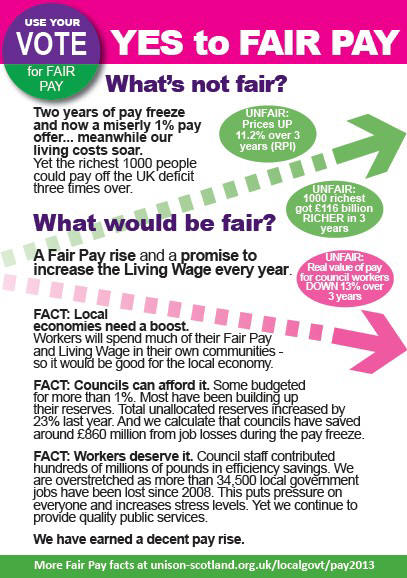 aying on as a Retired Member. The normal fee
of £15 is paid for by the local branch and you would then be
entitled to access the various deals and discounts avail-able
through UNISON, i.e. deals on Home, Car or Travel Insurance or
even access to UNISON Travel for discounted holidays.
aying on as a Retired Member. The normal fee
of £15 is paid for by the local branch and you would then be
entitled to access the various deals and discounts avail-able
through UNISON, i.e. deals on Home, Car or Travel Insurance or
even access to UNISON Travel for discounted holidays.
See the
UNISON Benefits page for more details.
http://www.unison.org.uk/benefits/special.asp
Moving On? Don’t lose your UNISON benefits
There are many reasons why you may be asked at
one time or another to sign a compromise agreement with
Clackmannanshire Council. (Recent examples have been equal pay
claims and voluntary severance )
One of the requirements of a
compromise agreement is that it must be signed by a solicitor.
Please keep in mind that as part of your Member-ship benefits
with UNISON that you are entitled to legal advice free of
charge, and this includes signing off on off on any such
agreements.
If you have been asked to sign such an agreement please contact
a UNISON Steward or the local branch office for some advice.
UNISON Solicitors sign
agreements free of charge.
Kilncraigs and New Ways of Working.
As everyone is probably aware, Clackmannanshire Council is relocating it’s staff from Green-field
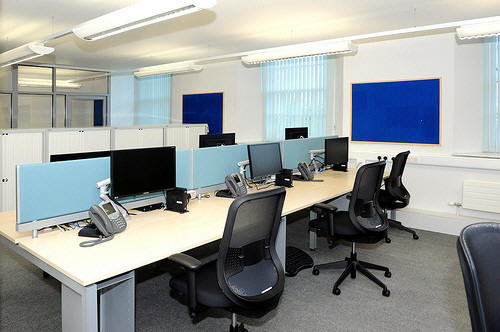
and Lime Tree House into Kilncraigs. This move is
being accompanied with a pilot exercise in ‘New Ways of
Working’.
These new ways of working are meant to do a
number of things including reducing the amount of space used by
staff (in order to save money) and to provide a more modern and
flexible
working environment for staff.
It is entirely
possible for both managers and staff members to benefit from
this assuming that these ways of working are
implemented
consistently and fairly across all services. That’s not to say
that every job is compatible with home or
remote working, however moving working
patterns to different times and using break out areas to have
meetings
instead of around desks can be helpful to both staff
and managers alike.
All the indications are that
Clackmannanshire Council is looking at this seriously and
policy and procedure documents are being drafted to help
managers to implement these new ways of working.
It is
UNISON’s job to support staff through any workplace issues
and as with any change, there will be challenges ahead in the
implementation of this new policy.
It is hoped that there
will no major difficulties arising from the moves into
Kilncraigs and/or the new ways of working, however we will
remain vigilant and will deal with any issues that arise. If you
have any concerns about any aspect of the move to Kilncraigs
or working in different ways, please contact your UNISON steward
or the Branch office and we will assist in any way that we can.
Help UNISON to help others by playing OCTOPUS
It’s fair to say that this is quite possibly the strangest headline I’ve ever written while doing the Clacks UNISON newsletter, however I feel it’s

perhaps one of the most important.

As I’ve
mentioned in previous newsletters ‘there for you’ (previously
known as UNISON Welfare) is a registered charity run by UNISON
which offers
assistance to members who may be struggling
through an unexpected crisis, or the pressures of every day
life.
They offer a unique confidential advice and support
service just for members of UNISON and their dependants.
Whether it's just a chat and a sympathetic ear, or more
concrete financial assistance, they may be able to help.
OCTOPUS is a monthly prize draw that is used to help fund ‘there
for you’, and so in turn to directly help our own members. I’ve
added the flyer below for general information however if you
would like to know more about it, or would like a Direct Debit application
form to sign up to the draw, please visit the website below
or talk to one of our UNISON Stewards.
www.unison.org.uk/octopus
Framework for LGPS Negotiations
Branch LGPS Pension Champions gathered in
Glasgow to give initial consideration to a framework for
negotiations on a new Scottish Local Government Pension Scheme
(LGPS), should the UK Pub-lic Service Pensions Bill be passed as
currently drafted. In this bulletin we focus on some of the key
issues members will need to consider as the negotiations
develop.
The current LGPS scheme will close in April 2015
and the new scheme will be heavily prescribed by the
provisions of the Public Service Pensions Bill. However,
that still leaves scope for negotiation on a range of issues
and the Scottish Government has made it clear that the only
requirements are that the new scheme is lawful and
affordable. We are currently, with the employers and
Scottish Government, collecting a wide range
of data that will influence our approach to many of the issues
below.
CARE Scheme
The new scheme must be a defined
benefit ‘career average’ (CARE) scheme as final salary schemes
will be unlawful. CARE schemes are explained in this UNISON
guide (http://www.unison.org.uk/pensions/careschemes.asp).
Generally, final salary schemes benefit members who gain
promotions later in their career. With CARE schemes the benefits
are spread more evenly across the membership and are reasonably
predictable but more complicated to calculate.
There may be further constraints on the type of
CARE scheme we can negotiate in Treasury regula-tions. However,
it will certainly require consideration of a new accrual rate
and restructuring the em-ployee contribution bands. The
revaluation rate is likely to be set by Treasury regulation. It
is im-portant to emphasise that the contribution ‘tax’ imposed
on other public sector schemes still does not apply to the
Scottish LGPS.
Retirement Age
The Normal Retirement Age
(NRA) must be the same as the state retirement age. That is 66
from 2020, 67 from 2026-28 and after that linked to life
expectancy estimates. This is likely to see the NRA rise to 70
and beyond.
In light of this we may wish to consider amending
the flexible retirement provisions and review the actuarial
reductions used for voluntary early retirement. However, any
improvements will have cost implications for all scheme members.
In the past we have taken the view that members who choose to
retire early should not be subsidised by those who work to the
NRA. The later retirement age has particular implications for
the Scottish scheme given shorter life expectancy and the wide
range of occupations covered by the scheme.
The state pension is likely to change with new
proposals in a UK government White Paper. This could also result
in an increase in members and employers National Insurance
contributions.
Cost Sharing
The 2009 scheme introduced cost
sharing provisions into the Scottish LGPS. However, the new
scheme must set an employer cost cap expressed as a percentage
of pensionable earnings. Again Treasury regulations may
constrain negotiations further.
Pension Update — Page 1
Pension Update — Page 2
Other Issues
While these are the three main
change requirements driven by the legislation we may wish to
consider reviewing other aspects of the scheme including:
Ill heath retirement. There is an outstanding
requirement from the agreement on the 2009 scheme to review
the working of the three tier system. We will publish an
assessment of this when the data is available. Certificate
of protection. Given the later retirement age and public
service reform we may wish to update these provisions.
Commutation of pension to lump sum. Members have the option
to commute pension on retirement into a lump
sum. The prevalence of this impacts on scheme funding and we may
wish to re-view the current �1 for �12 ratio. Death in service
arrangements. We will look at the current data and consider the
adequacy of current provision. Contribution and benefit
flexibility. The new English scheme has a 50/50 option whereby
mem-bers can pay half the contributions for half the benefits.
It does allow members to temporarily re-duce contributions at
times of financial strain and stay in the scheme. On the other
hand it risks creating elements of a two tier scheme. Partner
pensions. In particular the fairly low 1/160th accrual rate.
Definition of pensionable pay. In particular the inclusion of
non-contractual overtime and other additional payments to
reflect changing working patterns and contracts. Protections.
The Rule of 85 transitional protections and the proposed
protection of final salary and retirement age for those within
10 years of retirement at April 2012. These do have cost
implica-tions for other scheme members. Vesting period. This is
the period after joining the scheme when a member is entitled to
benefits. The current two year period is considered by some to
be too long.
Next Steps
Consideration of many of these
issues will depend on an assessment of the scheme and workforce
data. A sub-group of SLOGPAG is collating this data and we will
publish further details of the options as the ne-gotiations
develop. In the meantime branches are asked to begin
consultations with members on these issues. UNISON’s SLOGPAG
representatives are available to attend branch meetings to
facilitate such discussions.
There is a very tight timetable
for these negotiations unless our amendments to the UK Bill are
agreed. The main negotiations will take place over the next four
to six months with formal consultation in August/September
(including a ballot). The aim is to conclude a Heads of
Agreement by the end of September 2013.
Governance
We have
an outstanding action from the 2009 scheme agreement to review
the revised governance arrangements. In addition, the
Pensions Bill includes provisions for stronger scheme and fund
governance, something UNISON has long argued for. This will
therefore also be a feature of negotiations over the new scheme.
More information at:
Scottish Pension Web Pages: